Saturday, October 9, 2010
Pascal's Triangle
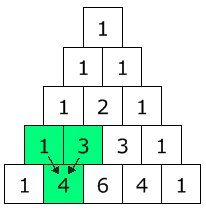
| One of the most interesting Number Patterns is Pascal's Triangle (named after Blaise Pascal, a famous French Mathematician and Philosopher). To build the triangle, start with "1" at the top, then continue placing numbers below it in a triangular pattern. (Here I have highlighted that 1+3 = 4) | ![]() |
the mythological explanation for the origin of this smear was that the goddess Hera was tricked into suckling the baby Heracles, son of her husband Zeus by the beautiful mortal Alcmene. But when she discovered who the baby was she tore her breast from his mouth, and her milk spurted across the sky. You understand, of course, that the gods lived in the sky.
There was also another legend that the Milky Way was created when Phaethon, son of Helios (the Sun-god) set the heavens on fire with his father's sun-chariot.
Ovid in Metamorphoses 1.168-71 saw it as the highway of the gods, leading to Jupiters palace.
| Quasars |
In the 1960s it was observed that certain objects emitting radio waves but thought to be stars had very unusual optical spectra. It was finally realized that the reason the spectra were so unusual is that the lines were Doppler shifted by a very large amount, corresponding to velocities away from us that were significant fractions of the speed of light. The reason that it took some time to come to this conclusion is that, because these objects were thought to be relatively nearby stars, no one had any reason to believe they should be receding from us at such velocities.
Quasars and QSOs
These objects were named Quasistellar Radio Sources (meaning "star-like radio sources") which was soon contracted to quasars. Later, it was found that many similar objects did not emit radio waves. These were termed Quasistellar Objects or QSOs. Now, all of these are often termed quasars (Only about 1% of the quasars discovered to date have detectable radio emission).Here are some Hubble Space Telescope quasar images, and the following figure shows the quasar 3C273, which was the first quasar discovered and is also the quasar with the greatest apparent brightness. It will be discussed further below.
![]() | ![]() |
| The quasar 3C273. Left image shows the quasar and the jet. Right image superposes on this contours of radio frequency intensity. The sharp radial lines from the quasar are optical spike artifacts because of its brightness | |
PROGRESS IN ASTRONOMY
The 20th century has been a remarkable period for astronomers with no signs that they have stopped making fascinating new discoveries or that they have yet solve all of the universe many puzzles
Astronomers:
- Henry Norris Russel
showed that all the stars are going through a life cycle of birth, maturity and old age
- Harlow Shapley
used variable stars as yardstick to give the first good estimate of the enormous size of our own galaxy the "milky way"
- Edwin Powell Hubble
showed the some nebula's, faint and cloudy spots visible through telescope are actually extremely distant "island universe"
-Hydrodynamics
-thermodynamics
RUDOLF CARNAP
-Logic
-Analysis
-Theory of probability
KARL POPPER
-Falsifiability
-Scientific method
THOMAS KUHN
-Paradigm shift or revolutionary science
WERNER HEISENBERG
-Quantum mechanics-is a set of scientific principle describing the known behavior of energy and matter that predominate of the atomic and subatomic scales.
Zeppeline - invented by Thomas Suillivan
Neon Light - George Claude
E=mc2 - Albert Einstein
Radio - !st radio Receiver
1910
Crossword - invented puzzle by Wyne
Pop-up toaster - by strite
Gas mask - Morgon
1920
Robot - artificial life
Penicillin - Flemming Begin
1930
Stop-action Photography - Edgerton
Frozen Foo - Birdeye
Electonmicroscope - Max Knott
1940
Jeep - Karl Pabst
Microwave - Spencer
1950
Video type recorder - Charles Ginsburge
Television - John Logie Bard
1960
Audio Cassel was invented
Spacewar - 1st come video game
1970
Floppy Disk - shuggart
Microprocessor - Faggin
1980
Mobile phones - Dr. Martin Looper
Computer - Charles Babage
Windows - program invented by microsoft
Disposable cameras - fugi
1990
World Wide Web - Time Lee
Java - Computer language
Friday, October 8, 2010
*In Britain, there was a marked absence of institutions providing jobs for researchers.
*In Germany, the natural sciences shared in the rise and size and prestige of the university system.
* William Henry Perkin - synthetic dyestuffs.
Progress in PHYSICS
- Hans Christian Oersted- electic current produces a magnetic field
- Michael Faraday- reverse effectJoseph Henry- built the 1st powerful electromagnets and invented the electric motor
- James Prescott Joule- 1st law of thermodynamics
- Wilhelm Roentgen- x-ray
- Marie Curie- gave the name radioactive, she and her husband Pierre Curi went on to discover polonium and radium
Progress in CHEMISTRY
- Friedrich Wohler- prepared urea in a test tube from inorganic starting materials
- Baron Justus Von Liebig- chemical fertilizers
- Dmitri Mendeleev- systematic and periodic arrangement
- Progress in ASTRONOMY
- Sir William Herchel- uranus did notb t precisely mve in its expected orbit
- Urban J.J. Everrier- neptune
Progress in BIOLOGY
- Karl Ernst Von Baer- embryology
- Charles Darwin- Origin of Speies
- Gregor Mendel- Pattern of inheritance of characteristic from one generation of sweet peas to other.
Progress in MEDICINE
- William Morton- anesthetics
- Louis Pasteur- methods of immunizing people
- Joseph Lister- antiseptic surgery
Walter Reed- yellow fever is caused by a virus carried by a mosquito
Friday, August 20, 2010
-a thing being drfine is called from the Latin definiemdum ; the expression which defines called a definiens.
Lexical
Intentional
Extensional
Contextual
Stipulative
Ontensive
Precising
Operational
AXIOMS AND THEOREMS
Axioms-is a preposition that is not proved or demonstrated but consider self-evident or subject to necessary decision.
Theorems-is a atatement which has been proven or has been established its validity.
Historical Background
The early Greeks dev. the logico deductive method where by conclusions( new knowledge) follow from premises(old knowledge)
Euclid established common notions
(very basic, self evident assertions)
1.Things which are equal to the same thing are also equal to one another.
2.If equals be added to equals, the wholes are equal.
3.If equals be subtracted from equals, the remainers are equals.
4.Things which coincide with one another are equal to one another.
5.The whole is greater than a part.
AXIOMATIC SYSTEM
-is any set axiom from which some or all axioms can be used in conjuction to logically derive theorems.
CHARACTERISTIC
Independent-derived from other axioms in the system.
Complete-if for every statement either itself or its negation is derivable.
Consistent-if it has contradiction.
-Greek word"astrom"-stars
-homos-law
During the 20th Century, astronomy split into two major categories.
PHYSICS TECHNOLOGY
A. Observational Astronomy
-focused in acquiring data from observation which then analyzed by the aids of basis of basic principles of Physics.
B.Theoretical Astronomy
-oriented towards the development computer or analytical models to described astronomical objects and phenomena.
Some Contribution of Early Civilization
Babylonians
-beggining of mathematical and scientific astronomy. They discovered the lunar eclipse recorded in repeating cycle known as "caros".
Greeks (3rd BC)
Aristacus
-calculated the mass of the earth and measures the distance and the size of the moon and star.
-he is also the first to proposed a heliocentric model of the solar system.
Hipparchrus
-invented the first and to proposed a heliocentric model of the solar system.
Astrolabe
-antikytheria mechanism (150-80 BC) was an early analog computer designed to calculate of sun, moon, etc.
Persians
Azophi-discover the andromeda galaxy and described in his book of fixed stars.
Egyptians
ALI IBN RIDWAN-first observed the SN( Super Nova) 1006 the brightest apparent magnitude stellar event recorded in the history.
2.Asteroids Belts
3.Outer Planets (consist of Gas, Giant Planets, Jupiter, Saturn, Uranus & Neptune)
Organizations of objects oytside the galaxy
1. Elliptical galaxy-has the cross section or shape of an ellipse where the stars more along a random orbits wiyh no prepared direction.
2.Spiral galaxy-stars is organized into a flat rotating with prominent bulge at the center.
*best example is the milky way and andromeda galaxy
Irregular Galaxy- chaotic in appearence and are neither spiral non eliptical it is like to gravitational enteracion.
Galactic Astronomy-study of galaxy
a.andromeda
b.milky way
emerged around 1100 B.C. Early Greeks have fully developed basic elements of mathematics, astronomy, physics, geography and medicine.B. Person who give contribution on the development of science
Aristotle - classification of plants and animals.
Archimedes - principle of lever and pulley
Ptolemy - geocentric theoryC. Roman Civilization
Time of Julius Caesar (102-44 B.C. ) - it is said that Romans are poor in science. But contributed a lot in the field of infrastructure.D. Romans that give contributions in the field of science.
Pliny the elder - only roman scientist that is celebrated.
Galen - Wrote 150 of books on medicine.
Cleopatra - Roman Queen who used cosmetics.
Lived almost entirely in the small nomadic communities.
surviving on his skills in hunting and fishing.
developed in tropical latitudes, especially in Africa.
moved out hence into the subtropical regions and eventually into the landmass of Eurasia.
Increased in population
Bigger communities
Begginings of town life
sometimes called as Neolithic Revolution
material that gives its name and technology unity.
became tools only when they were shaped delibarately for specific purposes and for this to be done efficiently.
Became a very popular stone for this purpose, although fine sandstones and certain volcanic rocks were also widely used.
stone headed spear
the harpoon
bow and arrow
Potter's Wheel- driven by kilks from the operator .
Wheels- gave continuous rotary movement in one direction .
Drill and the Lathe- derived from the bow and had the effect of spinning the drill piece.
Paleolithic-gathering fishing and hunting
Neolithic-agriculture, animal husbandry.
Impressive structure were created
primarily tombs
burial mounds and religious edifices
sun-dried bricks for domestic housing.
Grinding corn ( Quern ) - transport and communication .
Baking Clay ( Pottery)
Spinning and weaving textiles
Dyeing, fermenting and distilling
gold, silver, copper, tin
domestication of animals
dugout canoe and brick-bark canoe.
-A very important cultural transition began
Generated new needs and resources and accompanied by a signficant increase in a technological innovation.
the beggining of the invention of the city.
-Plotted the motion of heavenly bodies.
-Based calculations about calendar
-Relationship between science and technology have emerged.
-Medieval chemical art whose principles objectives where to find the panacea and to transmute base metals into gold.
-Makes the earliest known suggestions for furnishing a chemical laboratory.
Arabic numerals - an Indian system of numerical notation during the 19th century.
Persian Mohammed IBN Alkhwarismi is the Persian Mohammed
Constant preoccupation in the Islamic world. It was developed in Spain.
Cordova- located in Southern Spain.
Toledo- located in Central Spain.
Toledan- tables of proposition were drawn up in 1080.
The history of science and technology in India begins with the prehistoric human activity in Mehrgarh or Pakistan and continues through the Indus Valley Civilization also known as the Bronze Age Civilization to the early state and empires.
The Science And Technology in India has something to do with the following field:
Agriculture
Indian Astrology
Zinc Metallurgy
Mathematics
AGRICULTURE
-the Irrigation was developed in the Indus Valley Civilization by around 4500 B.C.
INDIAN ASTROLOGY
-Indian Astronomical text named Vedanga Jyotisa dates back around 1200 B.C. It detailed several astronomical attributes generally applied for timing social and religious events.
In India there is a long established widespread beliefs in Astrology and it is commonly used for daily life.
election process
Zinc Metallurgy
-Another important Indian contribution was in the Isolation, Distillation and use of Zinc.
-Early Iron objects found in India can be dated to 1400 B. C. Some scholars believed that by the early 13th century B.C. iron smelting was practiced on a bigger scale in India.
-Rust free steel was an Indian inventions and remained an Indian skill for centuries.
-the use of Negative numbers was known in early India and their role insituation like mathematical problems of debt was understood.
-the Decimal number system originated in India. Other cultures discovered a few features of this number system which was compiled in India where it attained coherence and completion.
The term “atomos” meaning uncuttable or the smallest indivisible particle of matter.
Dharmakirti and Dignaga
-Indian philosophers and founder of Vaishehika School of atomism.
They considered atom to be:
- point sized
- durationless
- made of energy
CHANDRASEKHAR LIMIT AND NUMBERS
-discovered by the named after Subrahmanyan Chandrasekhar, who received the novel prize in Physics for his work on stellar structure and stellar evolution.
INDIGO
Marco Polo- whose account of his travels and experiences offered European a firsthand view of Asian lands and Stimulated interests in Asian trade.
Zu Chongzhi- mathematician who calculated "pi" to the 7th digit.
Liu Ju-hsieh- mathematician who discovered "Pascal's Triangle"
Tao Ch'ien- famous poet and philosopher who influenced the ideaof "elixir of life".
-magnetic compass
-printing press
-gun powder
-paper making
Stellar explosion that took place in the "Crab Nebula" in 1054.
Mathematics
Military
Medicine
The Academia Dei Lencei in Rome ( 1603-1630 )
The Academia Del Cimiento in Florence ( 1657-1667 )
The Royal society in London (1662 )
The Academic Des Science in Paris ( 1662 )
Journal Des Savants of Paris ( 1665 )
Acta Ervditorium of Leipzig (1682 )
Principia mathematica of Sir Isaac Newton ( 1687 )
Traite De La Lumiereo of Christian huygens ( 1690 )
Johann Gutenberg ( 1450 ) - the invention of printing press.
German Cardinal Nicholas of Cusa (1402-64 ) - the latin exponent of the value of experiment.
Nicholas Copernicus ( 1403 ) - developed the heliocentric theory using scientific method.
Leonardo Da Vinci ( 1452-1514 ) -considered as the great artist of his time.
Andres Versalius ( 1514-1564 ) - founder of modern human technology.
Simon Stevinous - introduced the decimal fraction.
Galileo Galilei - made the telescope ( 1564- 1642 )
Johannes Kepler - theorized about the movement of the planet ( 1591-1630 )
Rene Descartes - inventor of the graph who believed in the God Existence.
Paracelsus - alchemist and physician of the renaissance.
Francis Bacon - improved scientific method.
Sir Isaac Newton - discovered the gravity.
-Migration or Barbarian Invasion
-Deurbanization
-Study of nature was pursued move for practical reason than an abstract inquiry
-Educational Reform ( Charles The Great)
-Birth of medieval Universities
-Latin translation of the main works of ancient philosophers and thinkers .
-Grosseteste (oxford franciscan School)
-Aristotle dual path of reasoning (resolution and comparison)
-William of Occam ( principle of parsimony)
-Jean Buridan ( most brilliant art master of MA ), theory of Imperatus
-Thomas Bradwardine ( Instantaneous Velocity )
-Nicole Oresme ( optics )
There were important breakthroughs in:
-iron and steel technology
-electricity
-weapons
-sociology psychology and biology
There were numerous applications such as:
-ocean liners with steel hulls
-skyscrapers
-electric trolley cars
In the study of physics, there was a much improved understanding of the nature of matter :
Dalton, an English schoolmaster, postulated a theory in which the atom was conceived as being a tiny billiard ball. Material of the same atom were elements. Material combining different elements were compounds.
Mendeleev began to develop the table of elements which helped in the discovery of new elements.
In the last decade of the century, the discovery of radium by Marie and Pierre Curie, and the electron by Becquerel as well as observation of radioactivity in the laboratory, challenged Dalton's theory.
Einstein produced the theory of the conversion of mass into energy, E=mC(2), which was confirmed by laboratory observations.
The theoretical foundations for a whole host of new inventions in electronics and nuclear power was laid. In the field of social sciences, the study of Sociology was conceived by Auguste Comte, who wrote of a heirarchy of knowledge:
1. Theological (fictitious)
Each level of knowledge was said to be more sophisticated than the preceding level.
In Psychology, Sigmund Freud looked for explanations for individual human behavior beyond the rational level. He understood people to be motivated by a superego (a conscience), an ego (the rational mind), and an id (subconscious motivation).
Monday, August 2, 2010
Philosophical Analysis
-General term for the process used by the philosophers in analytic tradition that involve breaking down philosophical issues.
Major Function of Philosophy
1. to construct theory about man and the universe.
2.to examine very carefully everything that maybe offered for a belief and its own theories.
Analysis
-from the Greek word "analusis" which means to breakdown; is the process of breaking down topic or substances to gain a better understanding.
Three Main Ways of Forming Analysis
1.Explication - which was so called by Carnap who work largely in the construction of
symbolic language.
2.Redefinition-It is associated with More by replacing term or statement which have the
same meaning with the same sort of language but which more carefully
formulated and more clearly understand.
3.Illustration- which takes the opposite point of view holding who practiced by
Wittgeinstein by just keeping close to multiplying use of one term to
another.
-confident understanding of a subject with ability to use for a specific purpose.
The 4 matter of facts
1.that something that exist
2.that something can be known
3that there is something which matter
4.that something including the 4 going statement
Four Branches of Philosophy
1.Ontology-the theory of being
2.Epistemology-the theory of knowledge
3.Axiology-the theory of value.
4.Logic- the theory of inferences
Other Sources of Knowledge
*customs and traditions
*sense perception
*intuition
PERCEPTION
-is the process of attaining awareness of understanmding of sensory information.
-means "receiving, collecting action of taking possesion Apprehension with the mind or sense.
FOUR KEY WORDS
PERCEPTION-->EXPERIENCE-->KNOWLEDGE-->SCIENCE
-acts of thinking
-that which one thinks
-opinion and reflection
-are really habits of expectations
-serves as a representation of an object
-it is idea or mental image
PERCEPTS
-views
-reflection
-impressions
Titchener
===>used to report what came into his head ehen he was using certain ideas" image theory".
Hume
===>used by introspecting to discover what the self look alike."bundless of perception"
Ryle
===>used ask the questioned about the concept.
Heraclitus
===>he recognized in perception are more or less arbitrarily carved out of the continous stuff.
The things in which the sign stands for:
*object
*sign
*interpreter
All language begin ordinary language under the process of immediate necessity of communication but not in all cases like.
1.customary usage how it spread
2.grammatical terms
3.declensions cases spread fall down.
Ordinary Language Analysis
- is the argumental that any language which is adequuate stands as the transmitter nuances or differences and styles of weaning on which every day conversion must be fluid.
Definition according to Gottfried Wilhelm von Leibniz
-it is the differentiation of two or more objects which is not ever exactly alike essential dissimilarity.
Platos Theories of Universals
1.Universalia in re (universal in thing)-everything is combination of form and matter.
2.Universalia ante rem (universal before things)-the link between the members of the class is that they are all imitation of an archetype which existed before the word was made.
3.Universalia post rem(universal after the thing)-nothing general exist, only particular.
4 Different types of similarities in descending order of usefulness for purposes of identification.
1.Genetic similarities-similar origins.
2.Structural similarities-same constituents in parts.
3.Functional similarities-similar behavior.
4.Apparent similarities-,same physical features.
-