Saturday, October 9, 2010

What is the importance of studying the history of science


FOR ME IT IS VERY IMPORTANT TO STUDY THE HISTORY OF SCIENCE TO BE FAMILIAR WITH THE CONTRIBUTORS IN THE FIELD OF SCIENCE AND TO KNOW WHAT ARE THEIR CONTRIBUTIONS AND TO APPRECIATE IT, TO KNOW THE PURPOSE OF EACH AND TO APPLY IN OUR EVERYDAY LIVES AND ALSO TO BE INSPIRED BY THEM.:))

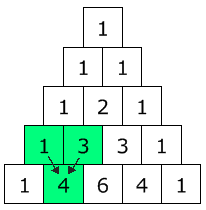
Pascal's Triangle

One of the most interesting Number Patterns is Pascal's Triangle (named after Blaise Pascal, a famous French Mathematician and Philosopher).

To build the triangle, start with "1" at the top, then continue placing numbers below it in a triangular pattern.

Each number is just the two numbers above it added together (except for the edges, which are all "1").

(Here I have highlighted that 1+3 = 4)

HOW DID THE MILKY WAY GET ITS NAME?


Nobody is sure how the Milky Way got its strange name. The ancient Greeks had several stories about it. According to Cassell's Dictionary of Classical Mythology, Jenny March, 2001:

the mythological explanation for the origin of this smear was that the goddess Hera was tricked into suckling the baby Heracles, son of her husband Zeus by the beautiful mortal Alcmene. But when she discovered who the baby was she tore her breast from his mouth, and her milk spurted across the sky. You understand, of course, that the gods lived in the sky.

There was also another legend that the Milky Way was created when Phaethon, son of Helios (the Sun-god) set the heavens on fire with his father's sun-chariot.

Ovid in Metamorphoses 1.168-71 saw it as the highway of the gods, leading to Jupiters palace.

Quasars

In the 1960s it was observed that certain objects emitting radio waves but thought to be stars had very unusual optical spectra. It was finally realized that the reason the spectra were so unusual is that the lines were Doppler shifted by a very large amount, corresponding to velocities away from us that were significant fractions of the speed of light. The reason that it took some time to come to this conclusion is that, because these objects were thought to be relatively nearby stars, no one had any reason to believe they should be receding from us at such velocities.

Quasars and QSOs

These objects were named Quasistellar Radio Sources (meaning "star-like radio sources") which was soon contracted to quasars. Later, it was found that many similar objects did not emit radio waves. These were termed Quasistellar Objects or QSOs. Now, all of these are often termed quasars (Only about 1% of the quasars discovered to date have detectable radio emission).

Here are some Hubble Space Telescope quasar images, and the following figure shows the quasar 3C273, which was the first quasar discovered and is also the quasar with the greatest apparent brightness. It will be discussed further below.

The quasar 3C273. Left image shows the quasar and the jet. Right image superposes on this contours of radio frequency intensity. The sharp radial lines from the quasar are optical spike artifacts because of its brightness

PROGRESS IN ASTRONOMY

The 20th century has been a remarkable period for astronomers with no signs that they have stopped making fascinating new discoveries or that they have yet solve all of the universe many puzzles

Astronomers:

  • Henry Norris Russel

showed that all the stars are going through a life cycle of birth, maturity and old age

  • Harlow Shapley

used variable stars as yardstick to give the first good estimate of the enormous size of our own galaxy the "milky way"

  • Edwin Powell Hubble

showed the some nebula's, faint and cloudy spots visible through telescope are actually extremely distant "island universe"

SCIENCE IN THE 20TH CENTURY


20th century technology developed rapidly communication technology transportation technology, broad teaching and implementation of scientific method and increase research spending all contributed to the advancement of modern science and technology.

20th Century's most contributors
Pierre Duhem

-
Hydrodynamics
-thermodynamics
RUDOLF CARNAP
-Logic
-Analysis
-Theory of probability
KARL POPPER
-Falsifiability
-Scientific method
THOMAS KUHN
-Paradigm shift or revolutionary science
WERNER HEISENBERG
-Quantum mechanics-is a set of scientific principle describing the known behavior of energy and matter that predominate of the atomic and subatomic scales.


20th Century Timeline
1900
Zeppeline - invented by Thomas Suillivan
Neon Light - George Claude
E=mc2 - Albert Einstein
Radio - !st radio Receiver

1910
Crossword - invented puzzle by Wyne
Pop-up toaster - by strite
Gas mask - Morgon

1920
Robot - artificial life
Penicillin - Flemming Begin

1930
Stop-action Photography - Edgerton
Frozen Foo - Birdeye
Electonmicroscope - Max Knott

1940
Jeep - Karl Pabst
Microwave - Spencer

1950
Video type recorder - Charles Ginsburge
Television - John Logie Bard

1960
Audio Cassel was invented
Spacewar - 1st come video game

1970
Floppy Disk - shuggart
Microprocessor - Faggin

1980
Mobile phones - Dr. Martin Looper
Computer - Charles Babage
Windows - program invented by microsoft
Disposable cameras - fugi

1990
World Wide Web - Time Lee
Java - Computer language

Friday, October 8, 2010

DIFFERENT STYLES OF RESEARCH

*In Britain, there was a marked absence of institutions providing jobs for researchers.
*In Germany, the natural sciences shared in the rise and size and prestige of the university system.
* William Henry Perkin - synthetic dyestuffs.

Progress in PHYSICS

  • Hans Christian Oersted- electic current produces a magnetic field
  • Michael Faraday- reverse effectJoseph Henry- built the 1st powerful electromagnets and invented the electric motor
  • James Prescott Joule- 1st law of thermodynamics
  • Wilhelm Roentgen- x-ray
  • Marie Curie- gave the name radioactive, she and her husband Pierre Curi went on to discover polonium and radium

Progress in CHEMISTRY

  • Friedrich Wohler- prepared urea in a test tube from inorganic starting materials
  • Baron Justus Von Liebig- chemical fertilizers
  • Dmitri Mendeleev- systematic and periodic arrangement
  • Progress in ASTRONOMY
  • Sir William Herchel- uranus did notb t precisely mve in its expected orbit
  • Urban J.J. Everrier- neptune

Progress in BIOLOGY

  • Karl Ernst Von Baer- embryology
  • Charles Darwin- Origin of Speies
  • Gregor Mendel- Pattern of inheritance of characteristic from one generation of sweet peas to other.

Progress in MEDICINE

  • William Morton- anesthetics
  • Louis Pasteur- methods of immunizing people
  • Joseph Lister- antiseptic surgery
  • Walter Reed- yellow fever is caused by a virus carried by a mosquito